
复仇者联盟
Bespoke tailor experiences top foreign tourists’ Shanghai travel list_我的网站

A |
But what are the facts on the ground?
China's Ministry of Commerce recently released a document titled China's Position on the So-Called Excess Capacity Issue. Reviewing the evolution of the global capacity landscape from a historical perspective, it offers an objective analysis of how industrial subsidies, trade surpluses, economic imbalances and market competition relate to "overcapacity," sets out China's policy practices and the direction of its efforts, and puts forward China's ideas and proposals - a forceful response to the "China overcapacity" narrative.
Plainly, the argument that "China's inadequate domestic demand gives rise to excess capacity" rests on a logical sleight of hand - it takes a localized phenomenon at the micro level of the market and applies it wholesale to the structure of the macroeconomy, a picture far removed from reality.
China is not only a major manufacturing power but also a major consuming power. Domestic demand has long been the main engine of the Chinese economy.
To see through the logical fallacy of the "overcapacity" narrative, one must first be clear about where the Chinese economy actually sits in the global landscape.
In the course of economic globalization, China has actively integrated itself into the international division of industrial labor and become the "world's factory" in the truest sense. Chinese manufacturing has enriched the global supply of goods, lowered living costs for consumers in countries around the world, and played an important part in easing global inflationary pressure. But to define China simply as a "producer" on that basis, and from there to conclude that it suffers from "inadequate domestic demand and overcapacity," is a proposition that does not hold water.
From 2013 to 2024, domestic demand contributed an average of 93 percent to China's economic growth, with consumption and investment accounting for an average of 55 percent and 38 percent respectively. China's total retail sales of consumer goods rose from 23.8 trillion yuan ($3.53 trillion) in 2013 to 50.1 trillion yuan in 2025, doubling in size.
Measured at the World Bank's purchasing power parity rates, China's total retail sales of consumer goods in 2025 were 1.7 times those of the US, making the country the world's largest market for consumer goods in all but name. China today ranks first globally in the physical volume of goods consumed, and its per capita annual consumption of some industrial products already approaches the levels seen in developed economies.
China keeps expanding its domestic demand and is working toward a higher-level balance between supply and demand.
Growth in China's total retail sales of consumer goods has slowed somewhat in recent years, and some have taken this as proof of weak domestic demand. That reading is neither objective nor complete.
A strong domestic market provides strategic support for Chinese modernization. The outline of China's 15th Five-Year Plan (2026-30) period devotes a dedicated part to building such a market, stressing the need to adhere to the strategic focus of expanding domestic demand, to expand effective investment, to further implement special actions to boost consumption, to promote the expansion and upgrading of commodity consumption, to unleashing the potential of service consumption, to strengthening the foundation of residents' consumption and to continuously improve the consumption environment - using new demand to guide new supply, and using new supply to create new demand, so as to promote a virtuous cycle between consumption and investment, and between supply and demand, achieve a higher level of dynamic balance between supply and demand.
The slowdown in retail sales growth is consistent with China's shift from high-speed growth to high-quality development, and it also reflects the upgrading of the country's consumption structure. China's consumer market is moving faster from one dominated by goods toward one in which goods and services carry equal weight. Spending on services is growing rapidly and is expected to account for more than half of the total by 2030.
China's super-sized market is not only the bedrock of its own development but also a broad platform on which countries around the world can share in the dividends of that growth.
China has ranked as the world's second-largest importer for 17 consecutive years and is a major export destination for nearly 80 countries and regions. It has granted zero-tariff treatment to 63 countries and regions, becoming the first major economy in the world to extend full zero-tariff coverage to every African country and every least developed country that has diplomatic relations with it. It is also the only country to host an international import expo, having staged eight editions of the China International Import Expo with cumulative intended deals worth more than $580 billion. Over the 14th Five-Year Plan period (2021-25) period, China's cumulative imports topped 90 trillion yuan. These facts and figures show clearly that China is not just the "world's factory" but, still more, the "world's market."
Looking ahead, China's middle-income group is set to exceed 800 million people within little more than a decade, and per capita GDP is expected to reach the level of a moderately developed country. With vast room for consumption and ample potential and vitality, domestic demand will remain the main engine of China's economic development and will keep injecting strong momentum into world economic growth.
This was compiled and translated by the Global Times English edition based on an article published in the "Chisu Jinsheng" economic commentary column of the People's Daily on August 6, 2026.
。
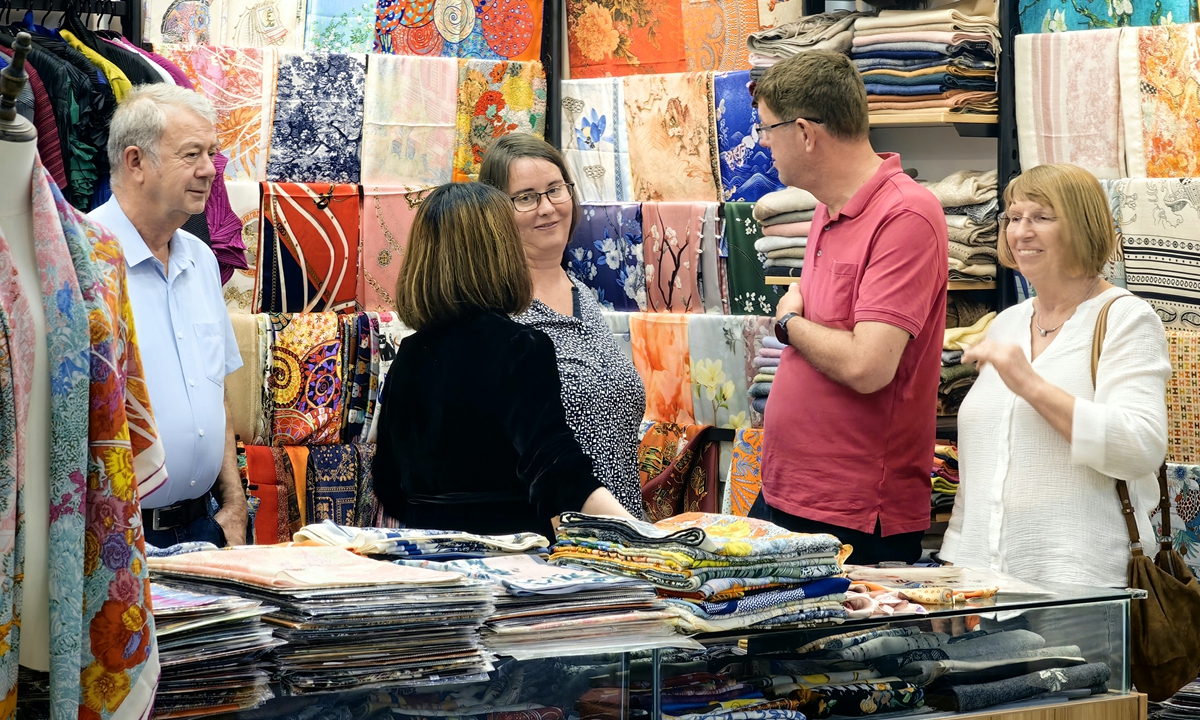
For many overseas travelers arriving in Shanghai, the Bund and the Oriental Pearl Tower are no longer the first stops on their itineraries. Instead, they head straight to the South Bund Soft Spinning Material Market, where custom-tailored outfits have become a signature experience driving "Chinamaxxing," a viral lifestyle trend popular among global travelers.
The market buzzed with energy, with conversations in various foreign languages echoing across storefronts, when a Global Times reporter visited it on a work day.
Tourists from different countries take body measurements, browse design references, and discuss tailoring preferences with local shopkeepers.
Evolving from the time-honored Dongjiadu cloth market, the area now hosts more than 280 fabric vendors and tailor studios, forming a complete industrial ecosystem for custom apparel.
Inside one local shop, two foreign tourists excitedly tried on a series of Tang-style garments, taking photos of their favorite looks before professional tailors record precise measurements for their custom-fit clothing.
Gabbo, an Italian traveler, told the Global Times that he first discovered the market through TikTok and Instagram. As silk markets in Shanghai have grown popular among Italian tourists, he and his travel companion Nicco came specifically to shop for authentic traditional Chinese garments and premium silk pieces.
"I picked out a brown Tang-style jacket and a white shirt, while Nicole got matching white shorts. We wanted to try something new and plan to wear our custom outfits out tonight because the styles are very fashionable," Gabbo said. "The bespoke measuring service is professional and thoughtful, and the whole shopping experience has been wonderful."
Intl tourists emerge as a major force
Benefiting from China's visa-free policy covering Italy, the pair only needed to submit standard tourist documents for entry. They plan to stay in China for roughly two weeks to explore local culture and lifestyles.
Local tailor shop owners have witnessed a striking surge in overseas customer demand. Driven by expanded visa-free policies and viral social media exposure, growing numbers of foreign tourists come to the market for original Chinese-style custom clothing.
According to shop owner Li, international visitors now account for 30 to 40 percent of her clientele, a dramatic reversal from previous years when domestic customers dominated orders.
"We source fabrics directly from suppliers and hire in-house tailors to eliminate middleman markups. Our bespoke pieces cost only one-third of similar custom outfits in Western countries," Li explained. The shop also offers expedited services tailored for short-stay travelers, allowing visitors to pick up finished garments within days.
All garments feature original in-house designs that retain classic Tang-style outlines with soft, wearable color tones suitable for daily wear. Many foreign customers style the traditional jackets with casual trousers and sneakers, creating unique, modern outfits that blend Eastern aesthetics and Western casual fashion, Li said.
Qian, another tailor with 20 years of industry experience, has also seen robust growth in overseas orders, with her annual order volume rising 20 percent year-on-year.
Most foreign visitors come for custom-tailored suits and enjoy the full immersive bespoke production process. Her workshop divides labor for suits, shirts and dresses to boost efficiency, once completing a full set of custom clothes and delivering them to a tourist's hotel by 10 p.m. on the very day of ordering. The studio also accepts personalized design drafts brought by international visitors.
Backed by the mature textile supply chain of the Yangtze River Delta, hand-tailored suits at the market cost merely one-quarter of equivalent bespoke outfits in Europe, with 24-hour rush order services available. This year, market foot traffic has increased roughly 30 percent year-on-year, with foreign shoppers making up 60 percent of all customers, the Global Times learned from the market.
Behind the change are China's visa-free policies. China's 240-hour visa-free transit policy covering 55 countries has greatly facilitated cross-border travel. Official data shows China received 22.91 million inbound foreign visits in the first half of 2026, a year-on-year increase of 20.4 percent, China Media Group reported.
From short-term visits to lasting influence
Boosted by China's visa-free policies, the social media trend "Chinamaxxing" has gone viral worldwide. Easier cross-border travel has allowed young foreigners to immerse themselves deeply in authentic Chinese lifestyles, including traditional fitness practices, Chinese dramas and local food culture.
Beyond garment customization, Shanghai's inbound tourism experience sector continues to expand. Spring Travel recently launched hands-on traditional snack workshops for foreign visitors, focusing on wonton and spring roll making. Tourists can cook, taste homemade snacks and learn the cultural stories behind local cuisine.
The workshops have received visitor groups from the US, Brazil and Australia and earned wide praise, the Global Times learned from Spring Travel.
Sugiurat Akuto, one foreign participant, said that making Shanghai snacks left him with precious travel memories. Before leaving China, he asked chefs for original recipes, hoping to recreate authentic Chinese delicacies at home and share his unique Shanghai travel experience with family and friends.
Unlike disposable souvenir purchases during routine sightseeing, custom-tailored clothes and learnable cultural skills turn short travel experiences into enduring cross-cultural connections. "These custom outfits will remain precious memories for decades. Even 20 years later, we will still remember custom-tailoring clothes in China. Every time I see these garments in my wardrobe, I will recall this special trip," Gabbo said, adding that distinctive local custom pieces are far more valuable than ordinary travel souvenirs.
Industry analysts note that the Chinamaxxing phenomenon marks a structural upgrade in China's inbound tourism consumption. Driven by optimized visa policies, foreign travelers are shifting from superficial landmark sightseeing to high-value, personalized immersive experiences. Longer stays and upgraded consumption drive coordinated growth of modern service industries and inject new vitality into China's service economy.
Research by the Shanghai Municipal Commission of Commerce shows that inbound tourists who opt for customized consumption stay an average of six to seven days in Shanghai, more than double the city's average 3.21-day stay for general foreign visitors.
Current cultural tourism experiential products represent only the initial stage of this emerging industry. China's rich cultural resources can be continuously developed into high-quality, replicable tourism offerings for global audiences, Zhang Yi, CEO of iiMedia Research, told the Global Times on Tuesday.
Most importantly, the Chinamaxxing trend boosts people‑to‑people exchanges. One‑off on‑site travel purchases translate into steady overseas demand and repeat orders, helping international audiences gain deeper insight into China's charm, Zhang noted.
。
Current article:http://ibdp17.suiyangguiduanzudoushaopao.buzz/cac/20260826/4346.html
Published on:14:25:41
格林第一季_Random reading
- 08-22打球难、约人烦、凑局累 一个免费工具撬动数千万运动用户
- 08-22回眸耕耘路·砥砺新征程
- 08-26深江铁路上跨广珠城际特大桥钢盖梁吊装完成,深江铁路上跨广珠城际特大桥钢盖梁吊装完成
- 08-21疫情通报:过去一周新西兰新增5757例
- 08-25中国男篮世预赛末节崩盘再负澳大利亚
- 08-24吉利银河A7率先首搭 吉利将于6月13日发布雷神AI电混2.0
- 08-23玩·美生活 幸福跨年|2025年寒假致家长的一封信
- 08-24劲嘉股份:转让控股子公司股权
- 08-26博主直播激活iphone14被封禁,这人也太勇了,经销商得倒大霉_iPhone_Pro
- 08-26每天一款新车上市?将“速度内卷”转向“质量竞争”,每天一款新车上市?将“速度内卷”转向“质量竞争”

痞子英雄_Active users
- 北京新发地市场启动紧急排查:涉事“甲醛白菜”未流入市场,当前市场白菜供应充足
- 出行注意!抚顺这一路段有施工,完工时间→
- 埃克森美孚、阿波罗等公司据悉有意竞购壳牌美国化工资产
- 英媒炒作伊朗发动网络攻击令英国电厂停摆4天
- Typhoon Dolphin inflicts downpours on multiple regions in China
- 外语学科最容易被AI取代吗:北理工外国语学院学者撰文回应
- 披露:美国国家航空航天局宇航员如何在新的载人航天器上训练
- 科前生物:上半年归母净利润1.16亿元,同比下降47.37%
- 上半年全国广播电视服务业总收入7513.89亿元,同比增长9.15%
- 央行8月14日将开展10000亿元买断式逆回购操作
- 幼培署今年将指定服务供应商 为学前教育领域提供代课服务
- 每日限流3万人次 五一假期陕西黄河壶口瀑布实名预约购票
- 另外三个Intel第9代CPU应运而生:Pentium G5420
- 加入广告联盟前,我是怎么调查一家平台的
- 记者:桑乔2500万镑买断条款已激活 切尔西不买断需付500万违约金
- 大佬气质!说唱歌手Jeezy晒与詹姆斯追梦等人在演唱会后台合影
- 王欣的新厕所mt应用程序“附近的人,遇到漂流瓶”的第一次体验
- 德国10年期国债收益率降至3.186%,创12日新低
healer_Hottest this week
- 08-2027岁维金斯官宣订婚!SGA等前队友送祝福 杰威调侃:本该是我
- 08-22蒂姆三盘鏖战不敌汉夫曼 错失冲冠良机无缘四强
- 08-25今晨一地突发3.4级地震!多地都有震感!网友:桌子跳了一下……
- 08-22Latiao: The spicy Chinese snack winning fans worldwide
- 08-22詹姆斯又一费城壁画亮相!重点赛事票价出炉:揭幕战已创最高纪录
- 08-22无语!奥克兰抢劫累犯强奸女生!法官这样判决……
- 08-25探访“中国云谷”:看见绿色算力的真实模样,探访“中国云谷”:看见绿色算力的真实模样
- 08-26典当行推荐:华夏典当行合规持牌、全国连锁、数智赋能、灵活便捷
- 复仇者联盟 copyright
- Some of the content comes from the Internet. If you have any offence, please raise it.